
Most roof problems start somewhere you can’t see from the ground. A slipped slate behind a chimney, a cracked ridge tile, a blocked valley or a flashing that has started to lift can all go unnoticed until water finds its way inside. Getting a proper look used to mean ladders, roof ladders or scaffold. A drone inspection gives you a close, clear view of the whole roof without anyone having to climb onto it.
This guide explains what a drone roof inspection in Barnsley can show, what it can’t, when it makes sense to book one, and how it fits alongside a hands-on inspection and repairs by a roofer.
What is a drone roof inspection?
A drone roof inspection is a visual survey carried out with a camera drone. The drone is flown around and above the roof to capture high-resolution photographs of each elevation and the areas that are hardest to reach. Those images are then reviewed by someone who knows roofs, so the findings come with practical advice rather than just a set of pictures.
Our drone roof inspection service covers homes, commercial buildings and industrial sites. It provides high-resolution roof imagery with clear findings and recommendations, and no scaffolding is needed at the inspection stage.
What a drone inspection can show
Because the camera can get close to every part of the roof, a drone survey is good at picking up visible defects on the outside of the building. That typically includes:
- Roof coverings: cracked, slipped or missing slates and tiles, and areas where moss or debris has built up
- Ridges and hips: loose, cracked or missing ridge tiles and failing bedding
- Chimneys: the condition of the stack, pots and pointing, which are often impossible to see properly from the street
- Flashings and abutments: lead or other flashings that have lifted, split or pulled away from a wall
- Gutters and outlets: blockages, sagging runs, damaged joints and debris
- Valleys: debris, damage or signs that water isn’t running away as it should
- Flat roofs: visible splits, blisters, ponding and staining on the surface
Drones are especially useful on large roofs and buildings where a ground level view tells you very little: big detached houses, terraces with rear extensions, farm buildings, and commercial or industrial units with wide flat or pitched roofs.
The images themselves are useful too. They give you a clear record of the roof’s condition at that point in time, which helps when you are deciding what work to prioritise and can support an insurance claim if you need to show the damage.
A note on thermal imaging
Some drone surveys also use a thermal camera for leak and moisture detection. A thermal image shows differences in surface temperature, which can point to areas where moisture may be trapped or heat is escaping. It is a helpful pointer, but it indicates rather than diagnoses. Temperature differences can have other causes, so any area that looks suspicious on a thermal image needs to be confirmed by a roofer on site before anyone decides on repairs.
What a drone inspection can’t show
A drone survey is a visual inspection from above, so it has limits.
- Fixings and connections: nails, clips and other fixings are hidden under the coverings, so their condition can’t be seen from the air.
- Underlay and battens: the layers beneath the slates or tiles aren’t visible unless something is already missing.
- The structure: a drone can’t tell you about the condition or strength of the timbers or deck beneath the roof covering.
- Moisture under membranes: on a flat roof, water trapped beneath the surface may not show in a normal photograph and needs physical checking to confirm.
The Designing Buildings Wiki guide to drone roof condition surveys makes the same point: a drone survey records the visible condition of the roof covering, but it is not a structural assessment and it cannot see what is concealed.
When you might choose a drone inspection
A drone isn’t needed for every roof. If the problem is a single slipped tile on a bungalow that can be checked safely, a roofer may simply take a look. A drone survey earns its place when:
- The roof is large, steep, tall or difficult to reach safely with a ladder
- The roof covering is fragile, such as some older sheeting or roof lights, and shouldn’t be walked on
- You manage a commercial or industrial site and need a clear picture of a big roof area
- You want to check for damage after a storm without putting anyone on the roof
- You are buying a property and want a closer look at the roof before you commit
- You want to find out what’s wrong before paying for scaffold just to look
If you are thinking of buying, our guide on whether to buy a house that needs a new roof covers the wider questions to ask.
How it fits with a hands-on inspection and repairs
A drone inspection is usually the first step, not the whole answer. The images show where the problems are and how widespread they look. From there, the next step might be a straightforward roof repair, a closer hands-on check of a particular area, or a plan for larger work.
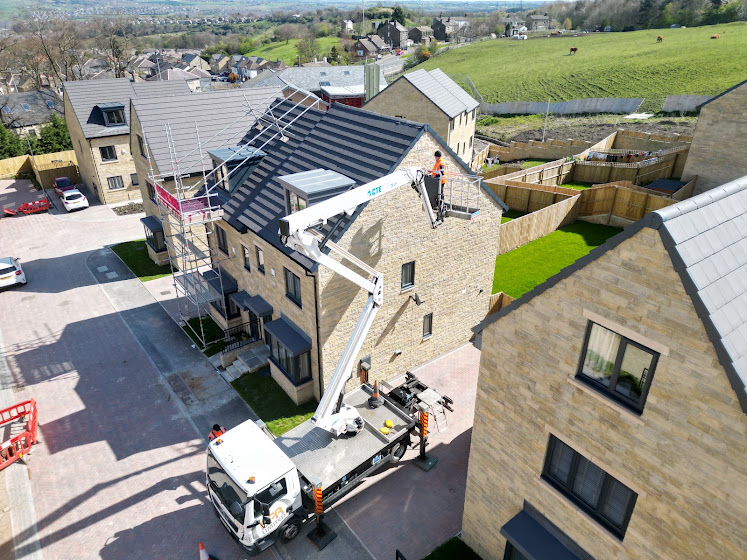
Where something can’t be judged from the air, such as the state of the fixings, underlay or timbers, a roofer will need to inspect it directly. On commercial buildings that might mean safe access using our powered access boom rather than full scaffold. For businesses, the drone images also help plan maintenance on commercial roofs, so work can be targeted where it’s needed.
Used this way, a drone survey can save time and money by making sure access equipment and labour are only arranged once you know what the job involves.
What to expect on the day
Weather
Drones can’t fly safely in strong winds or heavy rain, and wet or poor light can affect image quality. Occasionally a flight has to move to a better day.
Rules for drone operators
Drone flights in the UK are regulated by the Civil Aviation Authority, which sorts them into categories based on risk rather than on whether the flight is paid work.
- Open category: lower-risk flying with a maximum height of 120m. Anyone flying a drone of 100g or more needs a Flyer ID, and the operator usually needs an Operator ID too. The CAA Drone Code splits it into three subcategories. A1 allows the smallest drones to fly over people. A2 lets pilots with an A2 Certificate of Competence fly suitable drones closer to people. A3 requires flights to stay at least 150m from residential, commercial, industrial and recreational areas.
- Specific category: higher-risk flying, which needs an operational authorisation from the CAA before the flight. The usual route for working near buildings is the PDRA01 operational authorisation, which allows flights in built-up areas under set conditions, including keeping 50m from uninvolved people.
- Certified category: the highest-risk operations, regulated in a similar way to crewed aircraft. Roof surveys don’t fall into this category.
Because roof inspections usually mean flying close to houses and businesses, the A3 distance rule rules out most of them. Depending on the drone, a survey may be possible under A2 with the right certificate, but many professional operators work under an operational authorisation in the Specific category.
Whoever you use, it’s reasonable to ask which category the flight will be carried out under, what CAA registration and permissions the operator holds, and whether they carry suitable insurance.
Privacy and neighbours
The camera should be pointed at your roof, not at neighbouring gardens or windows. Good practice is to let neighbours know if a flight will be close to their property, keep the flight focused on the job, and store the images securely. In built-up streets around Barnsley, Dodworth or Darton, a quick word next door beforehand usually avoids any concern.
What you receive
After the flight, the images are reviewed and you get clear findings with recommendations on what needs doing. You can then decide on next steps with a clear picture of the roof in front of you.
Book a drone roof inspection
If you’re worried about your roof, need a clear view of a large or hard-to-reach building, or want to know what you’re dealing with before paying for access, a drone inspection is a sensible place to start. DPR is a family-run roofing company that has been looking after roofs across Yorkshire since 1989, including homes and businesses in Barnsley, Cawthorne and Silkstone.
Get in touch or call us on 01226 670 008 to talk it through.